


Introduction: The Managed Services Imperative
In today’s digital economy, your customers are shifting from traditional capital expenditure (CAPEX) models to operational expenditure (OPEX) frameworks. This transition is driven by a need to optimize costs, accelerate digital transformation, and focus internal resources on core business growth. Market intelligence confirms this trend: approximately 88% of organizations expect their managed services budgets to increase significantly over the next 12 to 18 months[1].
Cybersecurity is the primary catalyst for this investment. For you, as a Managed Security Service Provider (MSSP), this represents an unprecedented opportunity. However, capturing this demand requires more than just market presence; it demands a rigorous evaluation of your service efficacy. To succeed, you must address two strategic imperatives:
- Are your current offerings optimized for today’s security requirements and operational efficiency?
- What high-value opportunities exist to expand your portfolio into emerging domains?
This article – the first in a two-part series – covers the first imperative by providing a professional framework for auditing and optimizing your services to ensure you deliver maximum value to your customers and your business.
1. The Strategic Audit: The Cisco Health Check Lifecycle Review
The foundation of a high-performing managed service is continuous improvement. By leveraging a Cisco partnership, you gain access to processes like the structured Health Check Lifecycle Review. This is not merely a technical assessment; it is a holistic business audit designed to evaluate the success of a service from inception to market maturity and to provide you with actionable insights to improve your offer. While access to the Cisco run health checks is limited, a self-help version is being developed.
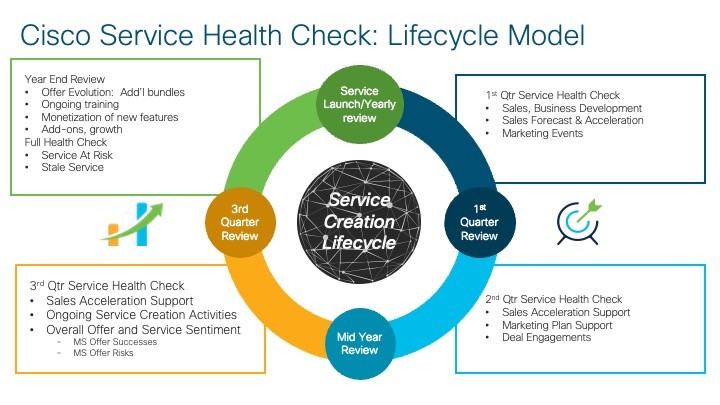
The review process examines your service through three critical lenses:
- Market Performance: Analyze adoption rates and customer feedback to ensure your service meets the actual needs of your target demographic.
- Go-to-Market (GTM) Efficacy: Evaluate your sales and marketing engine to identify gaps in the customer acquisition journey.
- Operational Viability: Assess the internal resources required to maintain the service and identify bottlenecks in support or deployment.
By conducting these reviews annually, you ensure your offerings remain agile, allowing you to pivot strategies and maintain a competitive edge in a shifting threat landscape.
2. Operational Excellence through Centralized Management and AI
Operational overhead is a major threat to your margins. To combat this, you must leverage technological advancements that consolidate management and automate routine tasks.
The Power of Security Cloud Control (SCC) Cisco’s Security Cloud Control (SCC) represents a paradigm shift in security management. One Cisco is a strategic direction from Cisco across all its products lines, in this case by providing a unified console, SCC allows your team to manage a diverse array of products—including firewalls (Physical & virtual), Multi-cloud Defense, Secure Access, and Cisco Hypershield to name but a few—without the “swivel-chair” inefficiency of multiple interfaces.
A critical differentiator of SCC is its support for third-party firewall vendors. In a heterogeneous environment where customers may utilize a mix of security technologies, the ability to manage Cisco and non-Cisco assets from a single pane of glass is a significant operational advantage. It reduces the learning curve for staff and streamlines policy enforcement across the entire estate while also setting up for the mirid of benefits that will come from using the Mesh Policy Engine to deliver against Cisco’s Hybrid Mesh Firewall strategy, helping you build a foundation of digital resilience for your customers.
Agentic AIOps and the 70% Efficiency Gain[2]
Another One Cisco imperative is AI-First innovations and the integration of AI Assistants and agentic AIOps within SCC is a great demonstration of this and perhaps the most transformative advancement for MSSPs. These tools are designed to automate complex, time-consuming administrative tasks, such as:
- Policy Configuration: Using natural language processing to quicken the deployment of complex rulesets.
- Error Reduction: Utilizing AI to identify conflicting policies or security gaps before they are deployed.
- Automated Audits: Streamlining the review of firewall rulesets to ensure compliance and optimal performance.
Data suggests that these AI-driven capabilities can reduce administration time by up to 70%2. For an MSSP, this time saving translates directly into increased margins and the ability to scale without a linear increase in headcount.
3. Streamlining the Lifecycle and Enabling SMB Security with Cisco Secure MSP Center
For managed service providers looking to rapidly deploy and monetize new security solutions, the Cisco Secure MSP Center offers a purpose-built platform. This console integrates core security pillars—including Cisco Umbrella, Secure Endpoint, and Duo—with Email Threat Defense (ETD) scheduled for imminent integration.
The Secure MSP Center is built upon the Managed Service License Agreement (MSLA), a pure consumption, post-paid commercial model. This model is essential for modern MSPs as it aligns costs directly with revenue, removing the financial risk of over-provisioning licenses. From a single interface, providers can manage the entire customer lifecycle—from initial trials and deployment to billing and commercial management—drastically reducing the complexity of back-office operations.
4. Building Differentiation through Premium Tiering
In a crowded market, “commodity” security services often lead to a “race to the bottom” on pricing. To avoid this, MSSPs can differentiate through sophisticated service tiering. While standard tiers provide a baseline, the introduction of higher premium tiers can serve as a powerful competitive advantage further differentiating your offerings in market.
Designed with customer benefit in mind, these premium levels of service can drive increased margin for the business as well as an excellent reward for customer loyalty or they could swing the prospect your way in a competitive situation, even if they are not initially purchasing this higher tier.
Integrating Digital Experience Monitoring (DEM)
A prime example of high-value differentiation is the integration of Cisco ThousandEyes into a managed firewall service. By adding Digital Experience Monitoring, an MSSP can offer visibility that extends beyond security into the realm of user experience.
If a customer experiences a performance degradation, ThousandEyes allows the provider to proactively identify whether the issue lies within the local network, the ISP, or the SaaS application itself, whether their ‘managed’ infrastructure is at fault or not. This level of insight transforms the MSSP from a “security vendor” into a “strategic partner” who ensures the overall health of the digital business. Even if a customer does not immediately purchase the highest tier, the existence of these premium options signals to the market that the provider is capable of supporting long-term, complex requirements.
Adopting Agentic AIOps
Another very cost-effective way of building new premium levels of service offerings is to use the constantly expanding feature set being delivered via Agentic AIOps capabilities to add new features and capabilities to your managed services, by adding these as part of a new premium service offering at a higher cost to the customer you are delivering increased margin to the business by utilising something that is free as part of Cisco’s administration platform and can be enabled by a very low headcount effort.
5. Evolving Your Commercial Model
The final pillar of optimization is the commercial framework. MSSPs should think about the opportunity to move away from rigid, per-device or per-user pricing in favour of models that reflect the value delivered. Engaging in a dialogue with customers about their preferred payment structures can reveal opportunities for:
- Bundled Solutions: Combining security, connectivity, and management into a single, predictable monthly fee, this moves you from just another vendor to a strategic partner for your customers.
- Outcome-Based Pricing: Aligning costs with specific business outcomes, such as uptime guarantees or threat mitigation metrics.
- Shared Responsibility Models: Demonstrating “skin in the game” by linking service fees to successful security outcomes, thereby increasing customer trust and long-term retention.
Conclusion: The Path to Sustainable Growth
Optimizing your services requires a balance of technical innovation and commercial agility. By leveraging Cisco’s lifecycle review processes, embracing AI-driven operational efficiencies, and innovating through premium tiering, you can enhance your profitability.
Cisco brings together networking, security, and observability to help you build digital resilience. By adopting this unified approach, you ensure your organization is not only meeting current market demands but is also positioned to lead in the future of managed security services.
[1] Source: Cisco / Everest Research joint study, July 2024
We’d love to hear what you think. Ask a Question, Comment Below, and Stay Connected with #CiscoPartners on social!
Cisco Partners Facebook | @CiscoPartners X | Cisco Partners LinkedIn


