


Just last year, Rwandan Minister of IT and Innovation Paula Ingabire called on countries to come together to confront cyber threats that are now unfolding at global scale. As she noted, emerging technologies—from AI and robotics to IoT and blockchain—are embedded across nearly every economic sector and giving rise to malicious actors who exploit the very tools designed to drive progress and opportunity. Her message was clear: collaboration and collective action are essential to combating cybercriminals.
At Cisco, we take these calls to action very seriously. Every day, cyber threats are accelerating in scale and sophistication—disrupting economies and undermining trust for billions of people worldwide. As a result, cybersecurity has become a core instrument of national power—shaping economic competitiveness, public trust, and geopolitical resilience. As digital systems now underpin nearly every function of modern society, governments face a simple but urgent challenge: securing what they depend on in an environment defined by constant disruption.
That is why we recommended that the Center for Cyber Security Law and Policy examine how countries around the world are confronting these risks and sharing proven, replicable best practices for building strong national cyber security strategies.
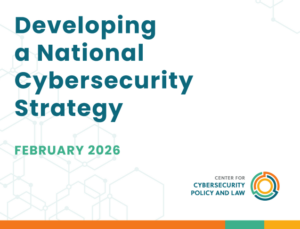
Drawing on our decades of experience working alongside governments, critical infrastructure operators, and industry partners worldwide, the playbook is designed to help leaders move from intent to execution.
What distinguishes this playbook is its focus on delivery. Rather than treating cybersecurity strategy as an abstract exercise, it is built for real-world conditions—tested against political constraints, institutional capacity, and operational risk. Its case studies span advanced and emerging digital economies, showing how governments are translating strategy into durable capability. From the U.S. and the EU, to the UK, Singapore, Colombia, Rwanda, and Australia, the approaches differ—but the conclusion does not: strategies succeed when they are enforceable, operational, and designed to hold up under pressure.
Why National Context Matters
A modern National Cybersecurity Strategy is foundational infrastructure. When done well, it aligns security with innovation and growth, while reinforcing the trust digital societies rely on.
But there is no universal blueprint. Countries start from different positions, shaped by their digital maturity, public–private responsibilities, regulatory capacity, and geopolitical realities. What works in one context may be impractical—or ineffective—in another.
Effective strategies are therefore adaptable by design. They draw on proven global principles while remaining grounded in national realities. The objective is not to replicate a model, but to build one governments can implement, sustain, and evolve over time.
Eight Pillars of a Modern National Cybersecurity Strategy
Across leading national approaches, eight policy pillars consistently emerge as essential:
- Cyber Workforce Development: Building long-term resilience through education, training, and public-sector talent pipelines.
- Secure-by-Design Standards: Embedding security into procurement, infrastructure, and digital services from the outset.
- AI Security Readiness: Governing AI risk while defending against AI-enabled threats.
- Preparation for Quantum and Emerging Technologies: Planning now for post-quantum cryptography and future shifts.
- Protection of Government Systems: Strengthening identity, asset visibility, patching, and incident response.
- Critical Infrastructure Resilience: Designing systems to withstand disruption.
- Harmonized Incident Reporting: Improving national visibility and coordinated response.
- Trusted Information Sharing: Enabling timely action through clear, secure, and predictable frameworks.
What is the key lesson? Leading national strategies show us that cybersecurity fails when it is fragmented. The strongest approaches treat it as a national capability—led from the center, executed in partnership, and reinforced through clear authority and expectations.
From Strategy to Execution
Still, even the strongest strategy has limited value if it cannot be carried into practice. Over time—and under pressure—execution is where national cybersecurity efforts are tested, refined, and ultimately proven. That is why sustained delivery matters as much as sound design. Cisco works with governments around the world to support this transition from strategy to execution—combining readiness benchmarking, educational and cybersecurity training, workforce development, and intelligence-driven defense to help build resilience that can evolve as threats change.
That resilience underpins far more than cybersecurity alone. It supports economic confidence, national security, and public trust in an increasingly digital society. As AI continues to reshape the risk landscape, governments that invest early in practical, adaptable strategies will be better positioned to manage emerging threats while still enabling innovation. We are committed to being a long-term partner in that effort—supporting governments as they build secure, resilient, and future-ready digital ecosystems, and ensuring that together, we are building better protections for our world.


